Stuck in the Slow Lane: How Consumer AI Chips Got Left Behind While Enterprises Raced Ahead
Let's be real for a second. If you've spent any time trying to run a serious AI workload on consumer hardware in 2025 — whether that's fine-tuning a language model, doing local inference on a multimodal system, or just trying to keep up with the latest open-source releases — you've probably hit a wall. A frustrating, expensive, bandwidth-starved wall.
That wall has a name: the enterprise-consumer hardware divide. And it's getting worse, not better.
The Dirty Math Behind the Divide
Here's the thing nobody at CES wants to say out loud: consumer GPU architectures are fundamentally not designed for the way modern AI workloads actually run. The chips sitting in your desktop or laptop were architected around gaming pipelines, rasterization, and the occasional GPGPU task. The memory subsystems, cache hierarchies, and on-chip interconnects all reflect those priorities.
Enterprise accelerators — your H100s, your MI300Xs, your Gaudi 3s — were built from the ground up with matrix multiplication throughput and memory bandwidth as the north star. The H100 SXM5 pushes roughly 3.35 terabytes per second of HBM3 bandwidth. A top-shelf consumer card? You're looking at somewhere in the neighborhood of 1 TB/s if you're lucky. That's not a minor gap. That's a different class of machine.
And memory capacity compounds the problem. Running a 70-billion parameter model in full precision requires somewhere around 140GB of VRAM just to load the weights. Consumer cards top out at 24GB. Even with quantization tricks, you're constantly fighting headroom limits that enterprise hardware never has to worry about.
Why Manufacturers Keep Deprioritizing You
This isn't some conspiracy. It's basic economics, and once you see the math, it makes complete sense.
A single H100 server node generates more revenue for NVIDIA than hundreds of consumer GPU sales. Data center customers sign multi-year contracts, buy in bulk, and don't return products because a driver update broke something. The incentive structure for chip manufacturers is overwhelmingly tilted toward enterprise customers, and that's been true for years.
What's changed recently is the magnitude of that tilt. The AI boom of the last two years created a feeding frenzy at the top of the market. Hyperscalers like Microsoft, Google, and Amazon are spending tens of billions on accelerator infrastructure. Every wafer that can be allocated to high-margin data center parts gets allocated there. Consumer products get what's left — which, in a constrained fab environment, isn't much.
The result is that the consumer product roadmap has effectively been in a holding pattern. You're getting incremental improvements — a bit more VRAM here, slightly better tensor core throughput there — but nothing that fundamentally closes the architectural gap with enterprise-class silicon.
The Architecture Time Warp Is Real
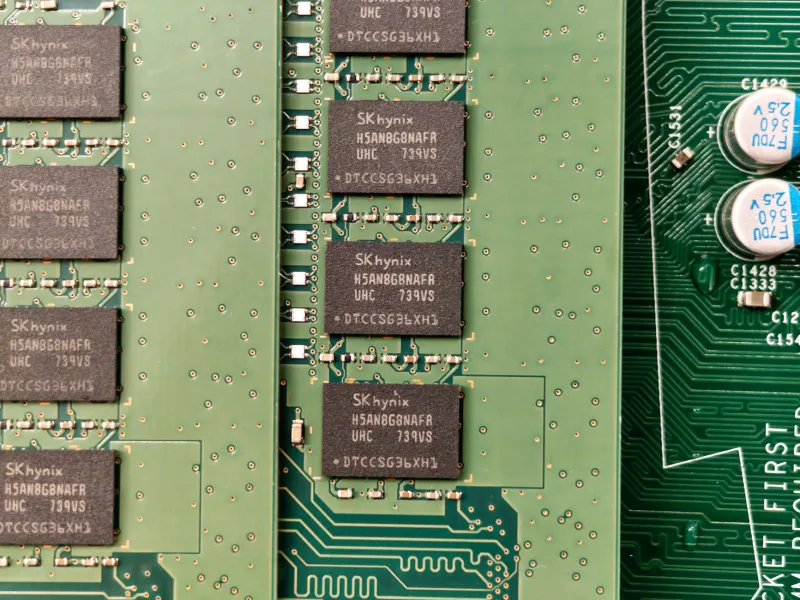
Want a concrete example? Look at memory technology. Enterprise accelerators moved to HBM (High Bandwidth Memory) years ago. It's stacked, it's fast, and it's purpose-built for the kind of wide, parallel memory access that AI workloads demand. Consumer cards are still on GDDR, which is cheaper to manufacture and perfectly fine for gaming, but starts to look pretty rough when you're trying to feed a transformer model that's constantly shuffling massive weight matrices.
Or consider interconnect. Enterprise systems use NVLink at scale, allowing multiple GPUs to share memory pools and communicate at speeds that make PCIe look like a dial-up modem. Consumer multi-GPU setups — to the extent they're even supported anymore — are limited to PCIe bandwidth that creates serious bottlenecks the moment you try to scale up.
This isn't just about raw specs. It's about the entire compute paradigm. Enterprise AI hardware is built around the assumption that you'll be running massive, sustained workloads where every nanosecond of latency and every byte of bandwidth matters. Consumer hardware is built around the assumption that you'll play a game for a few hours and then go to bed.
So What Can You Actually Buy Right Now?
Okay, enough doom and gloom. If you're a serious early adopter or independent developer trying to do real AI work without an enterprise budget, what are your options in 2025?
NVIDIA RTX 4090 — Still the Consumer King, For Now With 24GB of GDDR6X and solid Ada Lovelace tensor core performance, the 4090 remains the best consumer option for local inference. It's not cheap, but it handles quantized models up to around 70B parameters with some creativity. The 5090 is coming, but early specs suggest it's an incremental rather than transformational upgrade on the memory side.
AMD Radeon RX 7900 XTX — The Underdog Worth Watching AMD's ROCm software stack has matured considerably, and the 7900 XTX offers 24GB of GDDR6 at a price point that's genuinely competitive. If you're running PyTorch-based workloads and don't mind spending time on configuration, this is a legitimate alternative that often gets overlooked.
Used Enterprise Hardware — The Savvy Developer's Secret This is where things get interesting. Previous-generation enterprise parts like the A100 or even the V100 are starting to appear on the secondary market at prices that are within reach for serious hobbyists and small teams. You're not getting cutting-edge performance, but you are getting HBM memory, enterprise-grade interconnects, and dramatically more VRAM than anything in the consumer lineup. Worth investigating if you can handle the power and cooling requirements.
Apple Silicon — Surprisingly Viable for Inference The M3 Ultra and M4 chips use unified memory architecture, which means your CPU and GPU share a large, fast memory pool. An M3 Ultra with 192GB of unified memory can run models that would be completely impossible on any consumer discrete GPU. The tradeoff is training speed, which is still well behind CUDA-based systems. But for inference and experimentation, Apple Silicon has quietly become one of the best options for individual developers.
What's Actually Coming Down the Pipeline
The good news — and there is some — is that the competitive dynamics are starting to shift, at least a little. AMD is pushing harder on the consumer AI story. Intel's Arc lineup, while still finding its footing, is bringing more competition to the mid-range. And startups like Tenstorrent are targeting the prosumer and small-team market with architectures that prioritize AI workloads over gaming compatibility.
More importantly, the open-source AI community has become remarkably good at squeezing performance out of constrained hardware. Quantization techniques, efficient attention implementations, and smarter batching strategies have pushed the envelope of what's possible on 24GB cards considerably further than anyone expected two years ago.
The gap is real, and it's not going away anytime soon. But if you're willing to be smart about your hardware choices — and creative about your software stack — there's more room to operate than the raw spec sheets suggest. The enterprise players have the horsepower. Early adopters have the ingenuity. That's always been the deal, and honestly? It's still a pretty good one.