Analog Is Back, Baby: How Old-School Computing Is Rescuing AI From Its Own Energy Problem
Let's be honest: the AI industry has a power problem it doesn't love talking about in earnings calls. Training a single large language model can consume more electricity than a small American town uses in a month. Data centers are straining power grids from Virginia to Oregon. And the digital chips at the center of all this? They're running into hard physical limits that no amount of clever architecture is going to fully solve.
So here's the twist nobody expected: the answer might involve going backward. Not all the way back — we're not talking about punch cards and relay switches. But researchers and a growing number of well-funded startups are seriously revisiting analog computing, a paradigm that dominated before digital took over in the 1960s and never really got a fair shot in the modern era.
What Even Is Analog Computing, and Why Did We Ditch It?
In a digital system, everything is ones and zeros. Calculations happen in discrete steps, and precision is king. Analog computing, by contrast, works with continuous values — voltages, currents, physical quantities that represent data directly rather than encoding it in binary. Early analog computers were used to simulate physical systems: artillery trajectories, fluid dynamics, early aerospace calculations.
We moved to digital because digital is predictable. It's easier to program, easier to debug, and scales beautifully with manufacturing improvements. Analog systems drift, suffer from noise, and are notoriously hard to generalize. For decades, that tradeoff made total sense.
But here's what's changed: AI workloads, particularly inference — the process of actually running a trained model — don't always need perfect numerical precision. They need fast, energy-efficient approximations. And that's exactly what analog hardware does well.
The Energy Math That's Driving the Revival
Digital processors burn power doing two things: switching transistors and moving data around. Both of these operations have an energy cost that scales with complexity. The more parameters in your model, the more data needs to move, the more heat you generate, the more cooling you need. It's a vicious cycle.
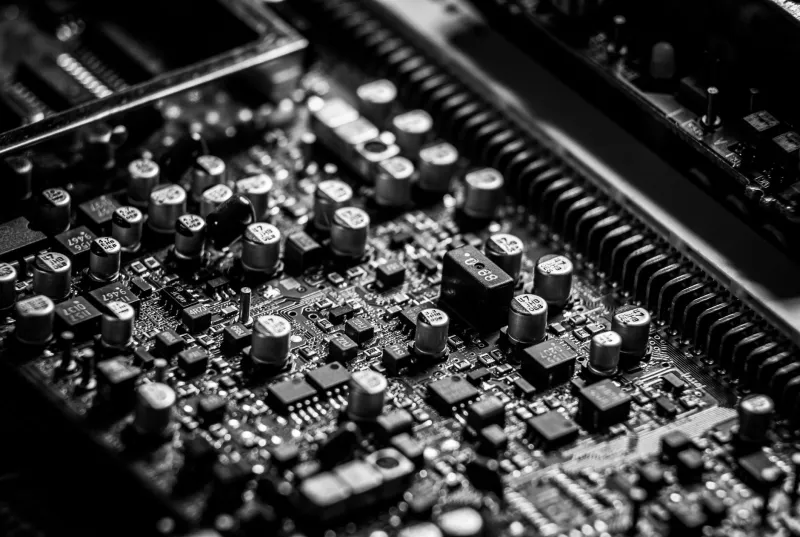
Analog circuits perform certain mathematical operations — especially the multiply-accumulate operations that dominate neural network inference — using almost no additional energy beyond what's inherent to the physical system. Resistors, capacitors, and transistors operating in their analog regime can compute directly in the physics of the circuit. No clock cycles. No memory fetches. Just physics doing math.
Some estimates suggest analog approaches could achieve energy efficiency improvements of 100x or more compared to digital equivalents for specific AI tasks. That's not a rounding error — that's a paradigm shift.
Modern Labs Are Rebuilding Analog With 21st-Century Materials
The old analog computers were built with components that drifted wildly with temperature and aged unpredictably. That's not acceptable in production systems. But materials science has come a long way.
Researchers at institutions including MIT, Stanford, and several DARPA-funded programs are building analog computing elements using memristors — resistive memory devices that can store and process data simultaneously. Others are exploring phase-change materials and ferroelectric transistors that offer more stable, controllable analog behavior.
Startups like Mythic AI have been pushing analog matrix processors specifically designed for neural network inference. Their approach stores model weights as analog conductance values in flash memory cells and performs computations in-place, dramatically cutting the data movement that kills efficiency in digital systems. IBM's research division has published work on analog AI chips that demonstrate this isn't just academic curiosity — it's engineering reality.
Where Analog Actually Gets Deployed Today
Don't expect your next gaming PC to have an analog processor. The current sweet spot is narrow but strategically important.
Edge inference devices are the primary target. Think smart cameras, industrial sensors, autonomous vehicle subsystems, and medical wearables — applications where battery life or thermal constraints make digital AI chips impractical. Running a vision model on a drone that needs to stay airborne for six hours? Analog inference hardware starts looking very attractive.
Signal processing pipelines are another natural fit. Radar systems, audio processing, and radio frequency applications have always had one foot in the analog world. Integrating analog compute into these pipelines reduces the constant analog-to-digital conversion overhead that wastes energy.
Neuromorphic hybrids represent the most ambitious frontier. Some research groups aren't drawing a hard line between analog and digital — they're building systems where analog circuits handle the energy-intensive approximation work and digital logic handles precision-critical control tasks. Intel's Loihi chips have explored this territory, blending spike-based analog-style computation with conventional digital infrastructure.
The Catch: Precision, Programmability, and Scale
Nobody's pretending analog computing is ready to replace GPUs in your data center. The challenges are real.
Noise and drift remain genuine engineering problems, even with modern materials. Calibrating analog systems at scale is complex and expensive. Programming models — figuring out how to map a trained neural network onto analog hardware — requires specialized toolchains that are still maturing. And manufacturing yield for some of these exotic materials is nowhere near the reliability of conventional CMOS processes.
There's also the question of reconfigurability. Digital chips are general-purpose by nature. Analog systems tend to be purpose-built, which limits their flexibility and increases development costs for new applications.
What This Means for the Next Five Years
Here's the realistic picture: analog computing isn't going to replace digital. It's going to complement it, carving out specific niches where its energy advantages are decisive.
The most likely near-term scenario is heterogeneous systems — chips that combine digital processing cores with analog inference engines, routing workloads based on precision requirements and power budgets. Think of it like how modern CPUs offload graphics to GPUs. The same principle, applied to the precision-versus-efficiency tradeoff.
As AI deployment scales from data centers to billions of edge devices, the economics of energy efficiency become overwhelming. A solution that's 10x less precise but 100x more power-efficient wins in a huge swath of real-world applications. Analog computing's moment isn't some nostalgic throwback — it's a pragmatic response to physics that digital architecture can't argue with.
The silent revolution is already underway. The engineers who are paying attention are placing their bets now.